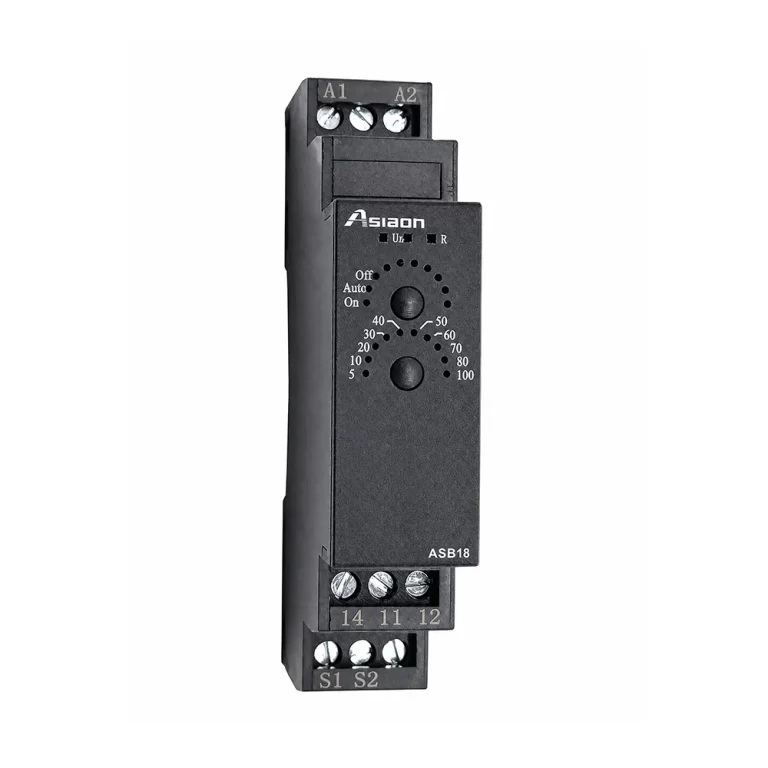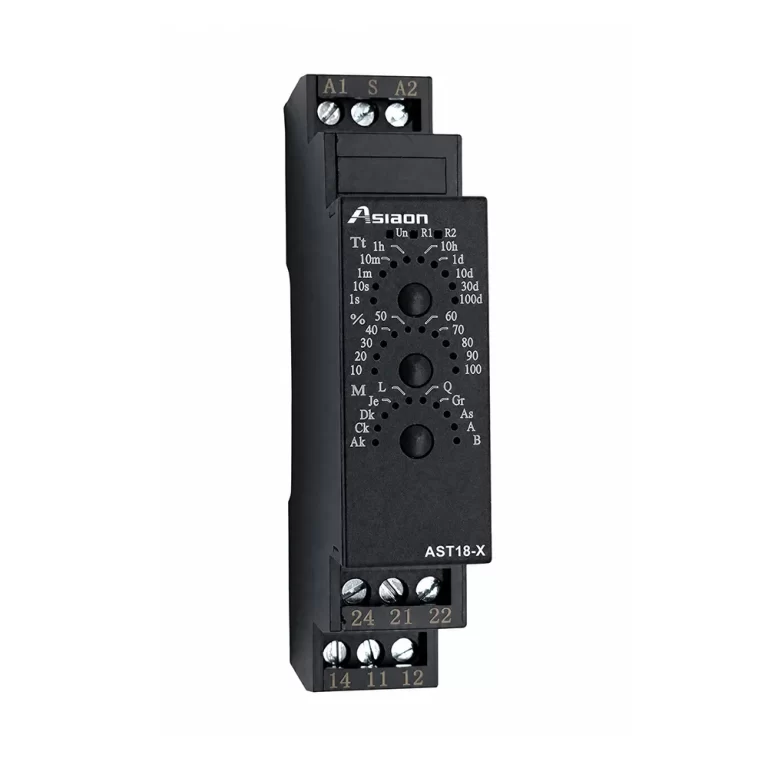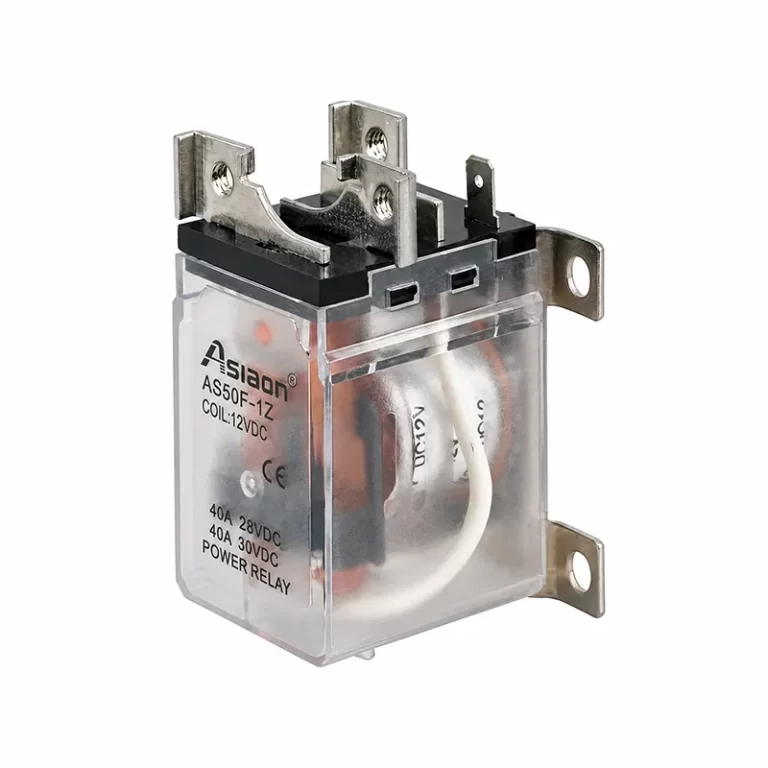


Timer relay accuracy and repeatability answer different questions: how close the delivered delay is to the intended setting, and how consistently that delay is reproduced under the same conditions. A timer can repeat a delay closely while remaining offset from the setting. Before choosing an industrial timer, identify the tolerance basis, timing start and stop events, supply conditions and temperature limits. Then verify the complete sequence using a suitable measurement method. Do not turn a percentage in a product table into a guaranteed process tolerance until its definition and test conditions are clear.
Separate setting error from repeated variation
Imagine setting a timer for ten seconds and observing several delays clustered around a slightly longer interval. The results may be consistent with each other, yet displaced from the selected setting. Turning the knob to compensate could bring the average closer to the target, but that adjustment alone does not establish performance over temperature, supply variation or future repeated settings.
In measurement terminology, repeatability concerns agreement between successive results under the same conditions. NIST’s terminology guidance also cautions that accuracy is a qualitative concept. Manufacturers nevertheless commonly use phrases such as setting accuracy and repeat accuracy in specifications. Treat those labels as an invitation to read the defined limits and calculation method, rather than assuming every supplier uses identical wording.
For procurement, keep three questions separate: the permitted difference from the selected delay, variation among repeated operations, and change when operating conditions change. This makes comparisons more useful than asking only which timer has the smallest advertised percentage.
Read the basis beside every percentage
A percentage requires a reference quantity. It might refer to the selected time, a range endpoint or another value defined in the specification. An absolute term in milliseconds may also be present. Obtain the manufacturer’s definition before calculating the available timing margin, especially when using the bottom of a wide adjustment range.
Consider a hypothetical 1% tolerance. If the document explicitly applies it to a 10-second setting, the corresponding amount is 0.1 second. If another document explicitly applies 1% to a 100-second full scale, the amount is 1 second. The calculation is percentage divided by 100 multiplied by the stated reference time. These are mathematical examples, not AST18 specifications or default rules for all timers.
Do not convert an undefined percentage by choosing the most favorable basis. Likewise, if a specification combines a percentage and a fixed time, clarify whether the terms are added, compared or applied differently. Record the complete expression and units in the purchase requirement so the same interpretation survives a later replacement.
Interpret the Asiaon table carefully
The AST18-A/B single-function time relay is a relevant starting point for an on-delay or off-delay inquiry. Its public table separately labels time deviation and repeat accuracy. That separation is useful, but the buyer still needs the applicable definitions, timing diagram and ordered variant documentation before using either field in a precision budget.
Do not treat the product family’s broad time range as a promise that one knob position delivers equal resolution everywhere. Identify the selected range, function and setting method. Ask how the setting is read, whether the permitted error includes the adjustment method and what conditions apply to the published figure.
The public page also contains environmental and temperature-related information. Request clarification of the applicable variant and units where needed, rather than extending a short table entry beyond its stated context. This guide deliberately does not translate those entries into a guaranteed machine-level tolerance.
Define exactly when timing starts and ends
A delay measurement needs two observable events. Depending on the selected function, the start may be an applied supply, a control transition or another documented event. The endpoint may be an output contact change. Specify both events before comparing observations from different test setups.
A controller command is not always the same event as the voltage arriving at the timer terminal. Similarly, a timer output transition is not necessarily the moment the downstream valve, motor or contactor completes its response. Record which interval the process actually requires and which interval the timer specification covers.
The IEC 63522-8 timing publication describes a standard test method for checking relay times against specified limits. Its public scope does not establish a tolerance for an Asiaon product or certify an individual installation. It supports the need for an agreed method and applicable limits before results are judged.
Use a timing review table before testing
This table is a practical checklist, not a list of universal performance limits. The terminology distinction follows NIST; the need to compare measured times with specified limits follows the IEC publication. Every acceptance value should be supplied by the relevant product documentation or the machine requirement.
| Review item | Evidence to record | Acceptance action |
|---|---|---|
| Setting tolerance | Percentage basis and any fixed time term | Calculate only after the definition is known |
| Repeated operation | Same start and stop events and test conditions | Use the specified repeatability calculation |
| Timing endpoint | Command, terminal event or output contact change | Match the measured interval to the requirement |
| Influence conditions | Supply and ambient conditions covered by the limits | Verify required conditions separately |
| Measurement | Instrument, trigger threshold and uncertainty | Resolve uncertainty against the available margin |
| Recovery | Required rearming and reset sequence | Allow the documented recovery before another operation |
When a row cannot be completed, pause the tolerance comparison and obtain the missing information. A carefully measured number cannot compensate for measuring the wrong interval or comparing against a limit whose basis is unknown.
Calculate a useful engineering error example
Suppose a hypothetical process requires an output transition between 9.8 and 10.2 seconds after a defined input event. Ten observations from a bench setup fall between 10.08 and 10.12 seconds. Their observed span is 0.04 second, calculated as the maximum minus the minimum. The midpoint of those extremes is 10.10 seconds. This span and midpoint are descriptive values, not a substitute for a manufacturer’s specified repeatability formula.
For an individual observation of 10.12 seconds relative to a selected 10.00-second delay, signed setting error is 10.12 minus 10.00, or +0.12 second. Expressed relative to that setting, it is +1.2%. State this reference explicitly. Do not label it a formal standard test result unless the required method and conditions were actually followed.
Those observations fit the hypothetical process window during that run, but approval still needs to consider measurement uncertainty and other required operating conditions. The small remaining margin cannot simply be assigned to temperature or supply effects without evidence. The purpose of the example is to separate arithmetic, observed variation and acceptance decisions.
Keep measurement limitations visible
A hand-operated stopwatch may be adequate for a coarse functional demonstration but insufficient for a narrow timing window. Select an instrument and trigger method that can resolve the margin being assessed. Document the instrument’s relevant uncertainty and the chosen event threshold rather than relying on the number of digits displayed.
Repeat measurements with the same method when assessing repeated behavior. If wiring, instrument, observer or triggering changes, record that change; the resulting differences may include the measurement system as well as the timer. Avoid rejecting a product based on inconsistent test conditions.
Do not open an energized industrial panel to improvise a timing test. Plan electrical work under the appropriate isolation and qualification procedures. For covered US workplaces, OSHA’s electrical work practices address deenergization and related protections. Use a suitably designed test arrangement and qualified personnel for the actual installation.
Check changed conditions separately
After establishing a baseline, identify which supply and ambient conditions the application requires. Compare results under those conditions using the agreed plan. A room-temperature bench result does not alone demonstrate the same behavior in a hot enclosure or during a supply disturbance.
Include sufficient recovery between operations according to the selected product’s instructions. A timer that has not rearmed can produce an apparently unusual delay for reasons unrelated to the setting tolerance. Also distinguish a normal repeated start from recovery after loss of power; the latter may follow a different documented sequence.
Do not add several percentage fields blindly. Some specifications may already include particular influences, while others describe them separately. Ask for the applicable combination method. Where the source does not define a complete error budget, qualification should resolve the gap instead of inventing a worst-case promise.
Compare alternative timer variants by function and evidence
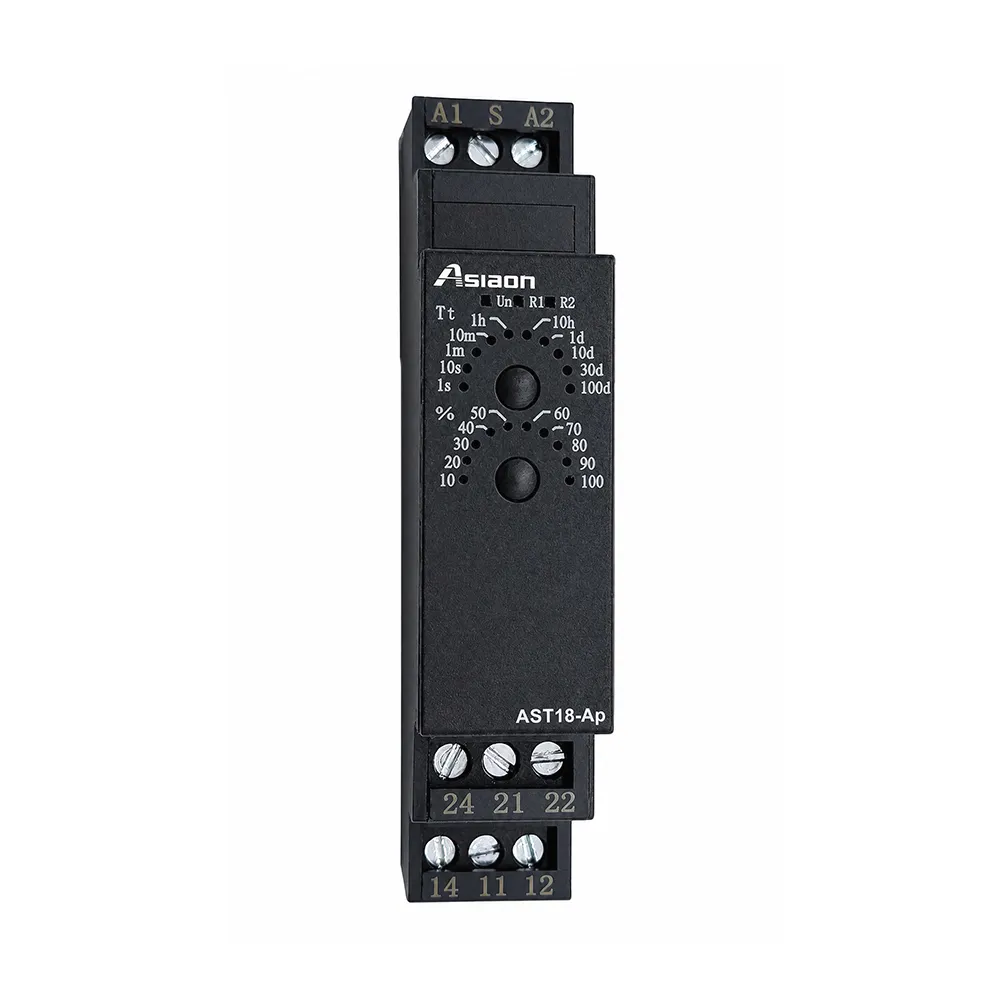
The AST18-Ap/Bp time relay is a separate product reference. Confirm its function, control requirements, output arrangement and timing definition before considering it as an alternative. A similar housing does not prove that its settings, reset behavior or tolerances match the existing device.
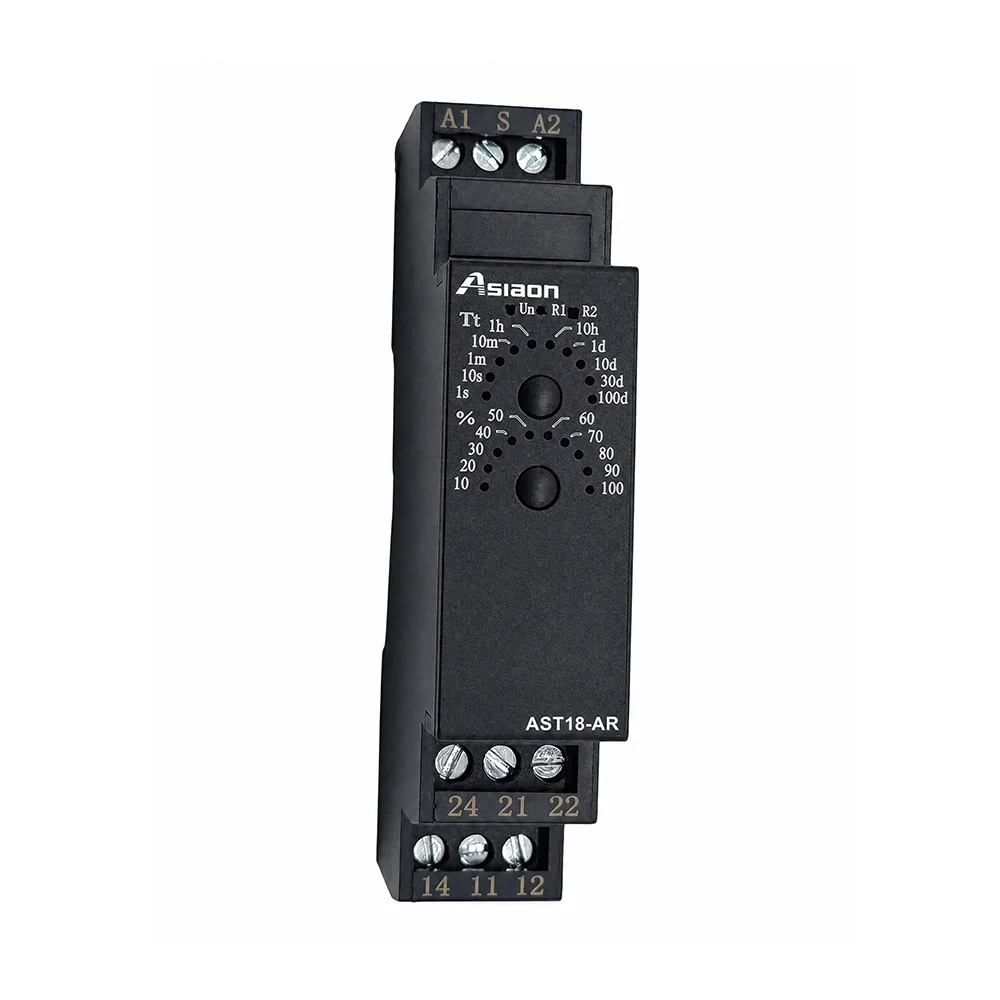
The AST18-AR/BR time relay provides another family-specific inquiry route. Keep the full code and the selected timing range in the comparison record. The photographs identify actual Asiaon products; they do not establish internal circuit design or interchangeable performance.
For an inquiry, supply the intended start event, required delay window, number of repeated operations, ambient conditions, supply behavior and downstream response requirement. Request the tolerance definitions and acceptance method together with the quotation. This helps the supplier answer the actual engineering question rather than simply repeating the headline range.
Frequently asked questions
Can a timer be repeatable but offset from its setting?
Yes. Successive delays can cluster closely while their average differs from the selected value. Evaluate agreement with the target and variation among repeated operations separately, using the applicable specification definitions.
Does a smaller percentage always mean a better timer?
No. Compare the percentage basis, any absolute term, range, operating conditions and measurement endpoint first. Percentages defined differently cannot be ranked reliably by their numerical size alone.
Can I adjust the dial once and assume the process is qualified?
No. An adjustment may improve one observed condition, but qualification must still address the required operating range, repeat behavior, measurement limitations and the complete downstream sequence.
Video: measurement and circuit background
Ben Eater demonstrates a monostable 555 timer. The demonstration introduces timing intervals and electronic pulse generation; it does not establish AST18 accuracy, calibration or internal circuitry.
Watch Monostable 555 timer – 8-bit computer clock – part 2 on YouTube
Related relay planning guides
For control component fundamentals, start with our general-purpose relay selection guide. Continue with on-delay and off-delay sequence selection, and timer power-failure restart checks.